Sponsored Links

Showing posts with label Datawarehouse. Show all posts

Wednesday, August 25, 2010

real time data warehousing

Sponsored Links
real time data warehousing
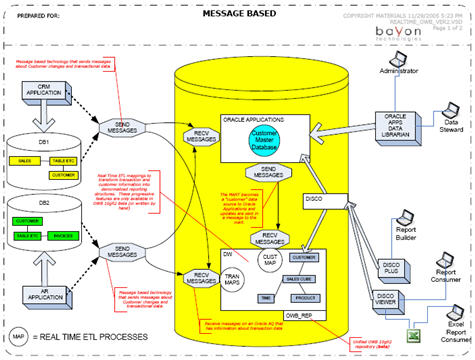
Also known as active data warehousing, real time data warehousing is the process of storing and analyzing data across multiple types of storage systems. Companies tend to use this approach in an ongoing effort to maximize the benefits from various forms of business intelligence, especially in terms of positioning the company for growth through sales. By capturing the information that becomes available and the assimilation of data with historical information, it is possible to predict shifts in customer demand, and develop new marketing strategies that will attract new customers.

Basic process real time data warehousing requires transactional data added to the database, such as placing orders or invoicing system, immediately analyzed, classified, and linked to information that has been shed from the previous transaction. Ideally, the additional information will yield additional information that helps to show the trend in purchases of goods or services offered by the company, the generation of profits or losses.

With assimilation and the rate of transactions and other data occurs, companies can move more quickly to take advantage of the trends that have the potential to recover significant business. Because real-time data warehousing process automatically, no need for anyone to turn this trickle of data from various transactional databases to a central database in real time. So, it is possible to access bank information is updated every time, and using data for planning future projects or actions that will be in accordance with corporate interests.

The process of data mining in real time can also include automatic generation of reports tailored to the needs of end users. Design a data warehouse often allows users to select from a series of pre-programmed report formats, or use a tool built into the software package to create a special report that manage data in many ways. This versatile data warehouse architecture makes it easy for companies of various sizes and related to different areas to use the same basic software, but adjusts the use software in accordance with their respective needs.

Most real-time data warehousing package also allows on-demand report generation and also on the schedule you set. This can be very helpful, as they may submit a request for a sudden moment, and the answer in seconds or minutes. For example, if a sales manager presented with a question about the sales day today is along the lines of a particular product, he can only frame the query, has a software pull-up-to-minute data, and reports that provide information with ease. other conventional methods would require up to half an hour or more to manage what real time warehouses can be set in less than three minutes.

Article Source:
http://www.wisegeek.com/what-is-real-time-data-warehousing.htm

Tuesday, April 6, 2010

Business Intelligence Solutions

Sponsored Links
What is the Benefit of a Data Warehouse As the Base For Your Business Intelligence (BI) Solution?
By Herbert Schoenek

Business Intelligence Solutions

Many BI vendors, particularly front-end solution-vendors, try to convince you that you do not need a data warehouse as a building or feeding mechanism for their front-end tool. This is a very bad advice and it will cost you dearly in the long run.

These vendors mostly offer you to put together a quick proto-type for one single source of your ERP-system (e.g. sales) and they build a simple data-feed and trick you with a nice looking front-end result of your data and push you in a sale. However, as soon you start trying to update the system on a daily basis or try to integrate other data sources you will find how difficult if not even impossible this is.

The secret sauce for your successful business intelligence system is not a sexy looking front-end, it is the work-horse of a data warehouse, which guarantees clean data, proper hierarchies, integration with a variety of data sources and much more. Only data warehouses make it possible to compare, consolidate and analyze data from a broad base of source data.

After your data is loaded into a data warehouse, it will not be changed except for correction of errors. This is the only way for you to guarantee that the front-end tools later show one version of the truth for answering business questions from a variety of users. I have seen this too often that different users came up with different results from the same source data only because everyone had applied different business rules when the data was extracted, so whom to believe?

There is a new business intelligence tool on the market which combines an easy to use data warehouse, a fantastic front-end tool for reporting and analytics and pre-defined interfaces (Quick Cubes) for a variety of ERP systems and business applications like sale reporting etc. It is called BDA - Business Data Analysis - and is very inexpensive and unbelievably fast to install (in just a few days).

Visit the website of BDA and register for a Webinar to learn more about how to build a data warehouse and business intelligence system.

For a limited period of time, BDA also offers a free Proof Of Concept (POC) with your own data, so Click Here to go to their website, click on the registration for the Webinar, ask for a one-on-one Webinar, followed by a POC.

Article Source: http://EzineArticles.com/?expert=Herbert_Schoenek